A crossword about someone: the 20-clue method.
Shop crosswords are about words. A crossword about a person is about the dog that was supposed to be temporary, and the only hard part is the twenty clues. This page is the method we use on every order, from the first list of memories to the answer key, with a complete 20-clue example so you can see what finished looks like.
Have it built from your clues, $39 See the full sample
Sam and Riley, the couple in the example, are invented. Every real crossword is built only from the clues the giver sends.
1. List the memories first, not the words
Do not open a crossword maker yet. Open a note and write thirty quick lines about the person: where you met, the pets, the dish they always cook, the phrase they say, the holiday that went wrong, the thing that broke the first winter. Fragments are fine. You are collecting, not writing. Thirty lines gives you twenty good ones after the next step throws some out.
Ask one other person who knows them, a sister or an old friend, for five lines of their own. The clues they add are the ones the solver will not see coming.
2. Turn each memory into one answer of 3 to 12 letters
Inside every memory is a noun that will sit in a grid. “We met at a bus stop in Portland in the rain” holds BUSSTOP, PORTLAND and UMBRELLA; take the one that gives you the best clue and keep the others as spares. Rules that keep the grid buildable:
- No spaces, no punctuation. Join two words: BUSSTOP, FIGUREITOUT. The letter count in the clue tells the solver it is two words: (3,4).
- Three to twelve letters. Shorter than three will not cross anything useful; longer than twelve will not fit a one-page grid.
- Mix the lengths. Two or three long answers (9 to 11 letters) to run across the middle, most of them 5 to 7, and three or four short ones (3 to 4) for the corners. All sevens makes a grid that will not close.
- Names are allowed, once or twice. Their name, yours, the dog's. More than that and the puzzle gets easy.
3. Check that the answers will actually cross
A freeform crossword works only where two answers share a letter. Vowels and R, S, T, N, L cross everything; an answer built from J, Q, X and Z crosses nothing. Write your twenty answers in a column and look for the common letters. If one answer shares no letter with any other, do not drop the memory, change the word: the place instead of the person, the dish instead of the restaurant, the month instead of the year.
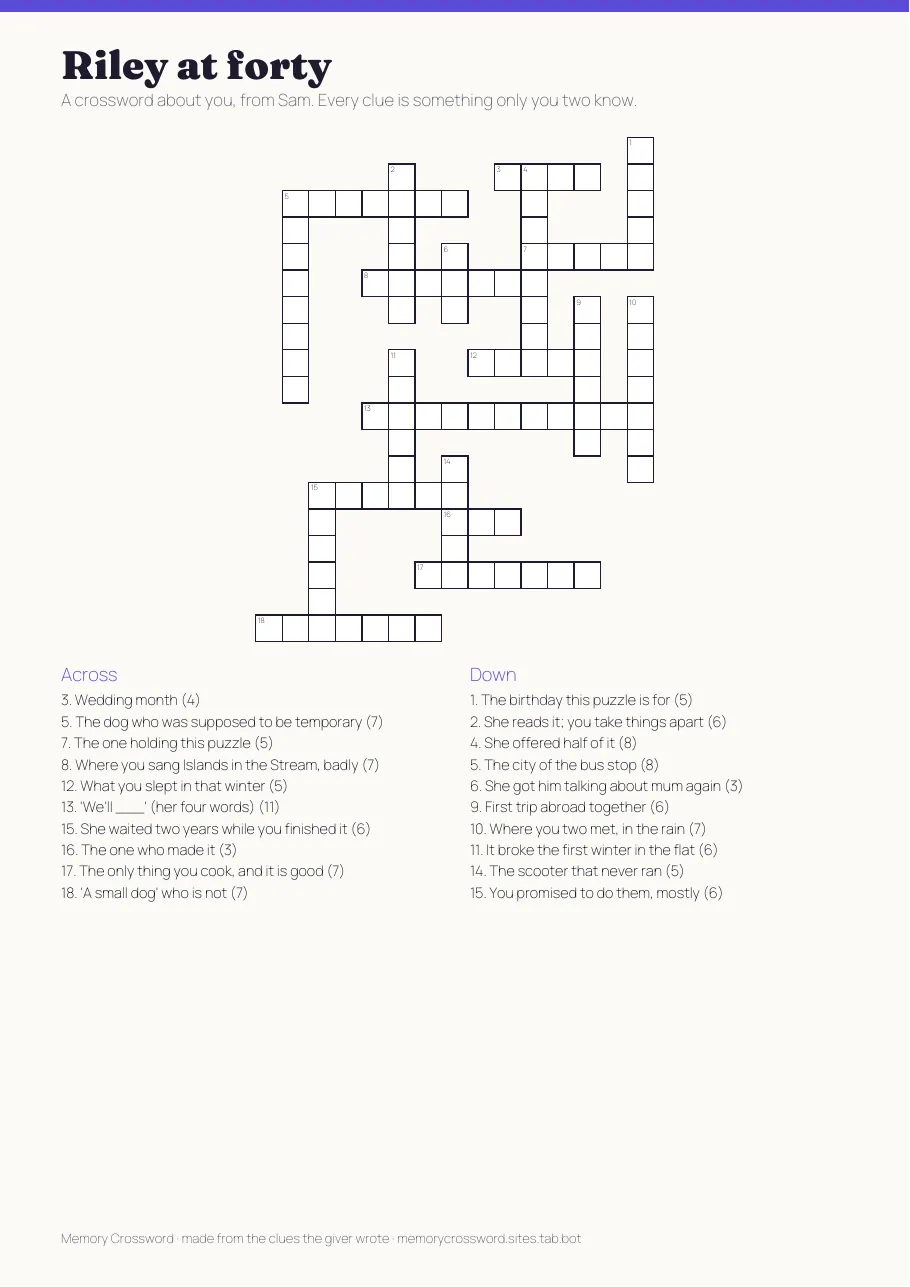
Here are the twenty answers Sam kept for Riley. Count the shared letters: PANCAKE and UMBRELLA share an A and an E; FIGUREITOUT, the long one, has four vowels to hang other answers off; DAD and SAM are the corner fillers.
PANCAKE – The dog who was supposed to be temporary
BUSSTOP – Where you two met, in the rain
UMBRELLA – She offered half of it
PORTLAND – The city of the bus stop
BOILER – It broke the first winter in the flat
BISCUIT – 'A small dog' who is not
MANUAL – She reads it; you take things apart
DISHES – You promised to do them, mostly
DEGREE – She waited two years while you finished it
COATS – What you slept in that winter
FORTY – The birthday this puzzle is for
RILEY – The one holding this puzzle
SAM – The one who made it
JUNE – Wedding month
LASAGNE – The only thing you cook, and it is good
VESPA – The scooter that never ran
KARAOKE – Where you sang Islands in the Stream, badly
LISBON – First trip abroad together
DAD – She got him talking about mum again
FIGUREITOUT – 'We'll ___' (her four words)
4. Write each clue so it reads like a real puzzle
This is the step no tool does for you, and it is the whole gift. A rough clue is a sentence to the person; a tidy clue is a crossword clue to the person. Four rules:
- Second person, present tense. “Where you two met, in the rain”, not “where we met”. The puzzle is addressed to them.
- Under twelve words. If the memory needs a paragraph, it is two clues.
- Never put the answer in the clue. “The pancake-coloured dog” gives it away. “The dog who was supposed to be temporary” does not.
- Letter count at the end, in brackets. (7), or (3,4) for two words. It is the one thing that makes it look like the back page of a newspaper.
Before and after, from the sample:
PANCAKE – The dog who was supposed to be temporary (7)
BUSSTOP – Where you two met, in the rain (3,4)
UMBRELLA – She offered half of it (8)
FIGUREITOUT – 'We'll ___': her four words (6,2,3)
A clue can be a fill-in-the-blank: 'We'll ___' (6,2,3). It can be a quotation. It can be unfair to anyone who was not there; that is the point.
5. Lay out the grid and number it
By hand: squared paper, pencil. Put your longest answer across the middle. Hang the next longest down from one of its letters, then across from that, working outwards and keeping the shape roughly square. Fill the corners last with your 3 and 4 letter answers. A twenty-answer grid usually ends up about 15 squares wide by 15 to 19 tall. Number every square where an answer starts, reading left to right then top to bottom, and list the clues as Across and Down in that order.
With software: any free crossword maker will take your answer-and-clue list and lay out a freeform grid in seconds. Check two things before you print: every answer crosses at least one other (no islands), and no accidental words appear where unrelated letters sit side by side.
6. Add the title, your line, and the answer key
At the top: their name and the occasion (“Riley at forty”). Under it, one line in your own words: “A crossword about you, from Sam. Every clue is something only you two know.” Page one is the empty grid with the clues under it; page two is the same grid filled in, for when they are stuck on 9 across. Print it on card, A4 or US Letter, and either frame it or fold it into the card. Hand it over with a pen.
This is the sample order finished: Sam's twenty clues above, built into a 15×19 grid where every answer crosses another.
Open the sample PDF (puzzle + answer key)
Or send us the clues and we build it
If the twenty lines are written and the grid is the part you do not want to do, that is our one service. You type your clues into the form on the home page; within 1 day you get a numbered freeform grid where every answer crosses another, your clues tidied with letter counts, their name and your line at the top, and the answer key on page two, as a print-ready PDF. One free round of changes, and we never change a fact or add one.
Also £32 incl. VAT · A$59 · C$55. Questions first? memorycrossword@mail.tab.bot
Questions
How many clues does a custom crossword need?
Fifteen to twenty-five. Fewer than fifteen leaves a grid with big empty corners; more than twenty-five stops fitting on one page at a readable size. Twenty is the sweet spot: a full page, solvable in an evening.
How long should the answers be?
Three to twelve letters, no spaces. Join two words (BUSSTOP, FIGUREITOUT). Mix lengths: a few long answers to run across the middle, lots of fives to sevens, and three or four short ones to fill the awkward corners.
Why won't my answers cross?
Freeform crosswords only work when answers share letters. Vowels and the letters R, S, T, N, L cross easily; answers full of J, Q, X and Z rarely cross anything. If an answer has no common letters with the rest, swap it for another word about the same memory (the place instead of the person, the dish instead of the restaurant).
Can I make one for free?
Yes. Free crossword makers online will lay out a grid from your answer-and-clue list, usually in a standard look with no title or key page. The method on this page is what makes the result worth giving: the clue writing is the part no tool does.
Can someone build it for me from my clues?
Yes. That is what Memory Crossword does: you type your 15 to 25 lines of ANSWER – clue, and within 1 day you get a numbered freeform grid where every answer crosses another, your clues tidied with letter counts, their name and your line at the top, and the answer key on page two, as a print-ready PDF (A4 or US Letter), for $39 (£32 incl. VAT, A$59, C$55). One free round of changes.